About nano_x7n4r0

This author has not yet filled in any details.
So far nano_x7n4r0 has created 176 blog entries.

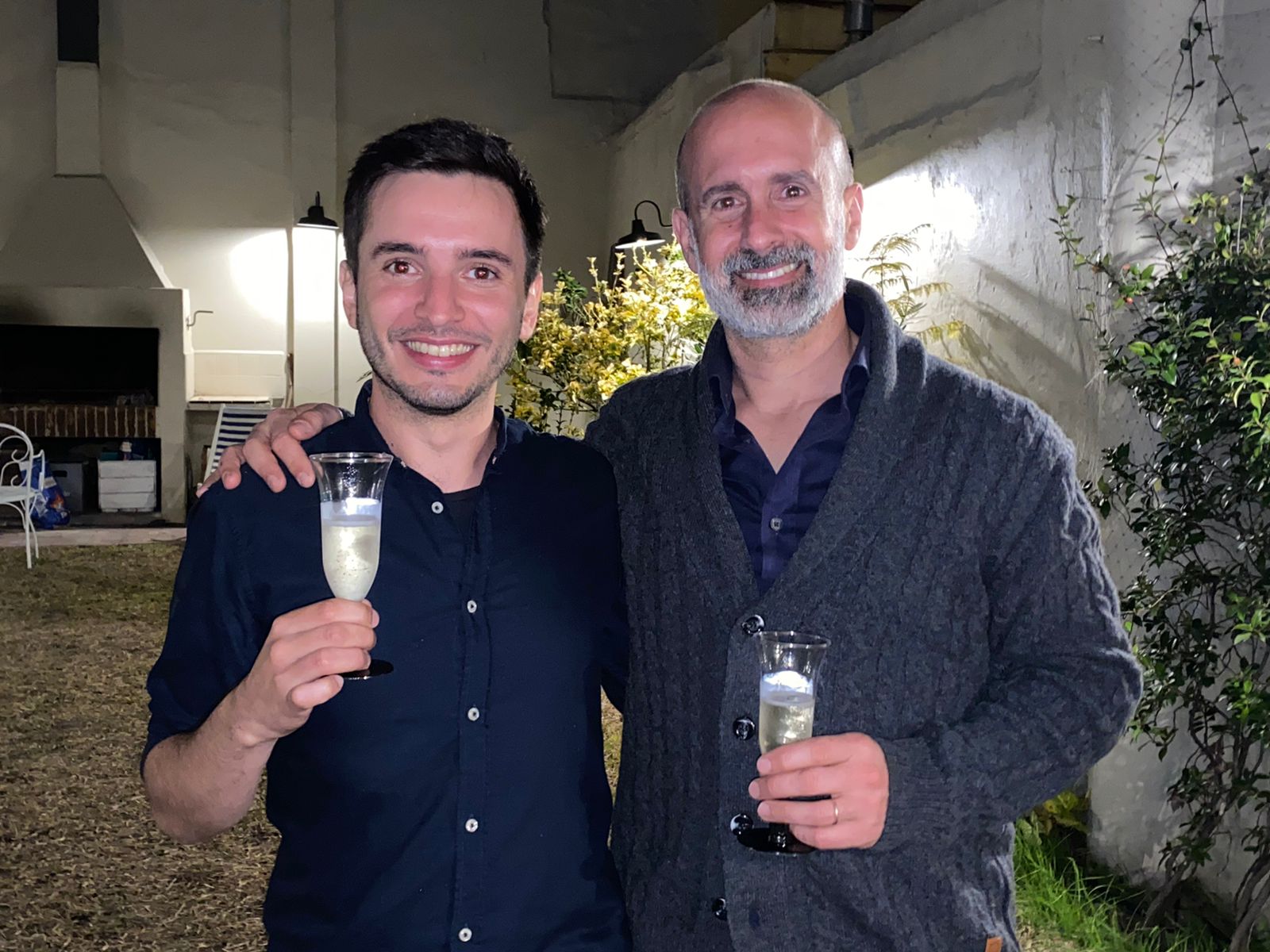
Congrats Dr. Luciano Masullo!

2021-09-06T17:08:38+00:00August 30th, 2021|

Today, Luciano Masullo defended his thesis "Photon-efficient fluorescence nanoscopy by scanning light intensity minima" and obtained the highest grade from the jury (Prof. Dr. Oscar Martínez, Prof. Dr. Valeria Levi, and Prof. Dr. Jorge Torga). Luciano joined our group in 2014, for his graduation thesis. At that time he worked closely with Dr. Fede Barabas, [...]
Congratulations Florencia!

2021-05-21T14:56:20+00:00May 21st, 2021|

Today, Florencia Edorna obtained her degree in Physics from the University of Buenos Aires with the highest grade. Florencia came to our group wishing to work on 3D STED and MINFLUX nanoscopy, incorporating adaptive optics schemes to bring those methods to their maximum performance by correcting aberrations in the optical system and the samples. Unfortunately, [...]

Congratulations Fernando Caprile!

2021-05-19T11:02:36+00:00May 18th, 2021|

Today, Fernando Caprile obtained his degree in Physics from the University of Buenos Aires with the highest grade. Fernando came to our group wishing to perform single-molecule experiments and to learn the latest advances in fluorescence nanoscopy, in particular about MINFLUX. Unfortunately, the COVID-19 outbreak made it impossible for us to go to the lab. [...]

Divulgación – Viendo el interior de las neuronas

2021-04-13T17:40:17+00:00April 13th, 2021|

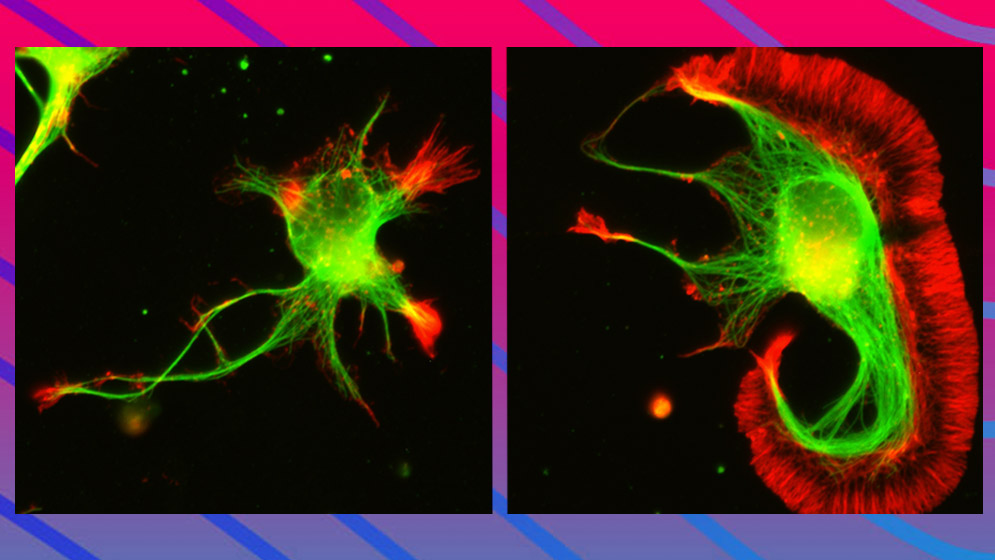
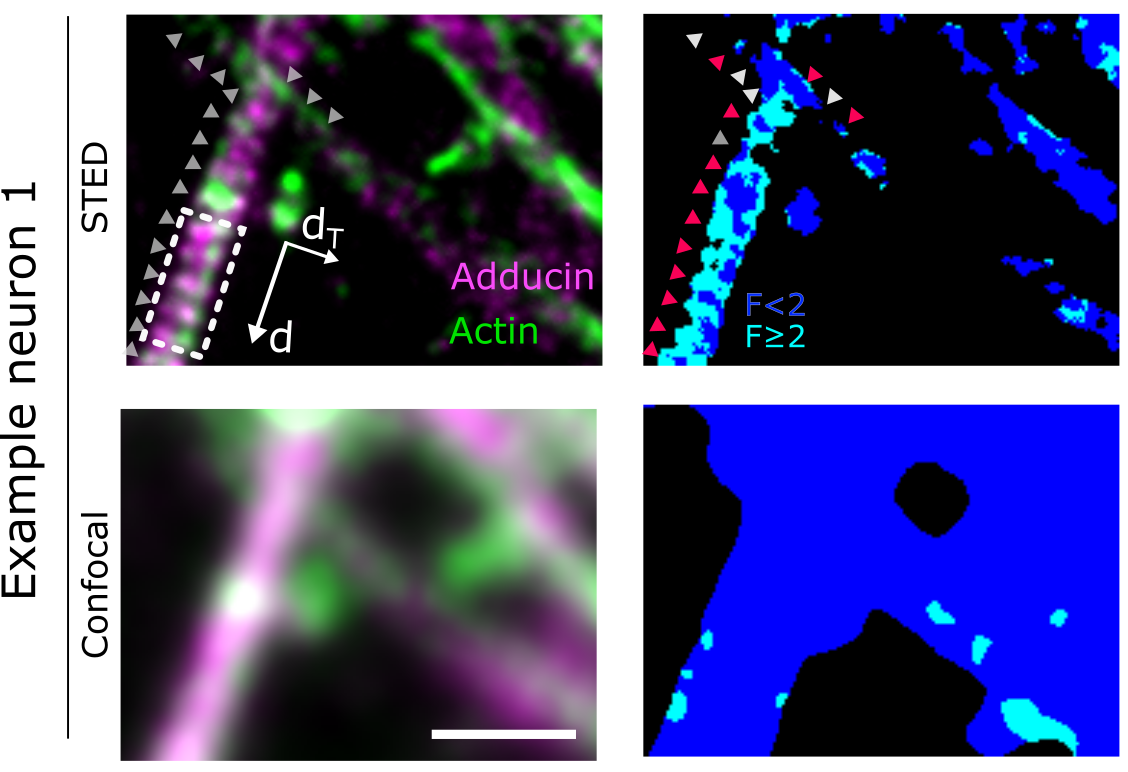
CONICET publicó una muy linda nota sobre el trabajo interdisciplinario que venimos llevando adelante con los grupos de neurobiología de los Dres. Alfredo Cáceres y Damián Refojo, destacando los últimos logros publicados en Nature Structural and Molecular Biology, Nature Communications y Nano Letters. En el artículo titulado "Viendo el interior de las neuronas", se describe [...]

Focus on Microscopy 2021

2021-03-31T22:46:18+00:00March 31st, 2021|

This year, the traditional conference Focus on Microscopy - FOM2021 - was held as an online edition from Sunday March 28 to Wednesday March 31, 2021. Our group participated with three contributions: 1) Luciano Masullo presented pulsed interleaved MINFLUX Luciano A. Masullo, Florian Steiner, Jonas Zähringer, Lucía F. Lopez, Johann Bohlen, Lars Richter, Fiona Cole, [...]

Orienting single-molecules in DNA-origami

2021-03-20T19:36:00+00:00March 4th, 2021|

DNA-origami technology is wonderful to fabricate all kinds of nanoscopic objects by self-assembly. We, in particular, use them to fabricate nanophotonic devices. That involves placing photon emitters alongside nanoparticles of different materials on well-defined nanometric geometries. DNA-origami is unique in the sense they provide great positional and stoichiometric control; we can decide where to place [...]

Finally! Super-resolved FRET imaging

2021-03-20T19:11:52+00:00February 24th, 2021|

Förster resonance energy transfer (FRET) from a fluorophore in the excited state (donor, D) to a fluorophore in the ground state (acceptor, A) provides a signal sensitive to D−A separation distances in the 0−10 nm range, and to various environmental parameters. A vast number of FRET imaging protocols and sensors have been developed and applied [...]

3D TIRF nanoscopy with sub-10 nm resolution

2021-03-31T22:45:52+00:00January 23rd, 2021|

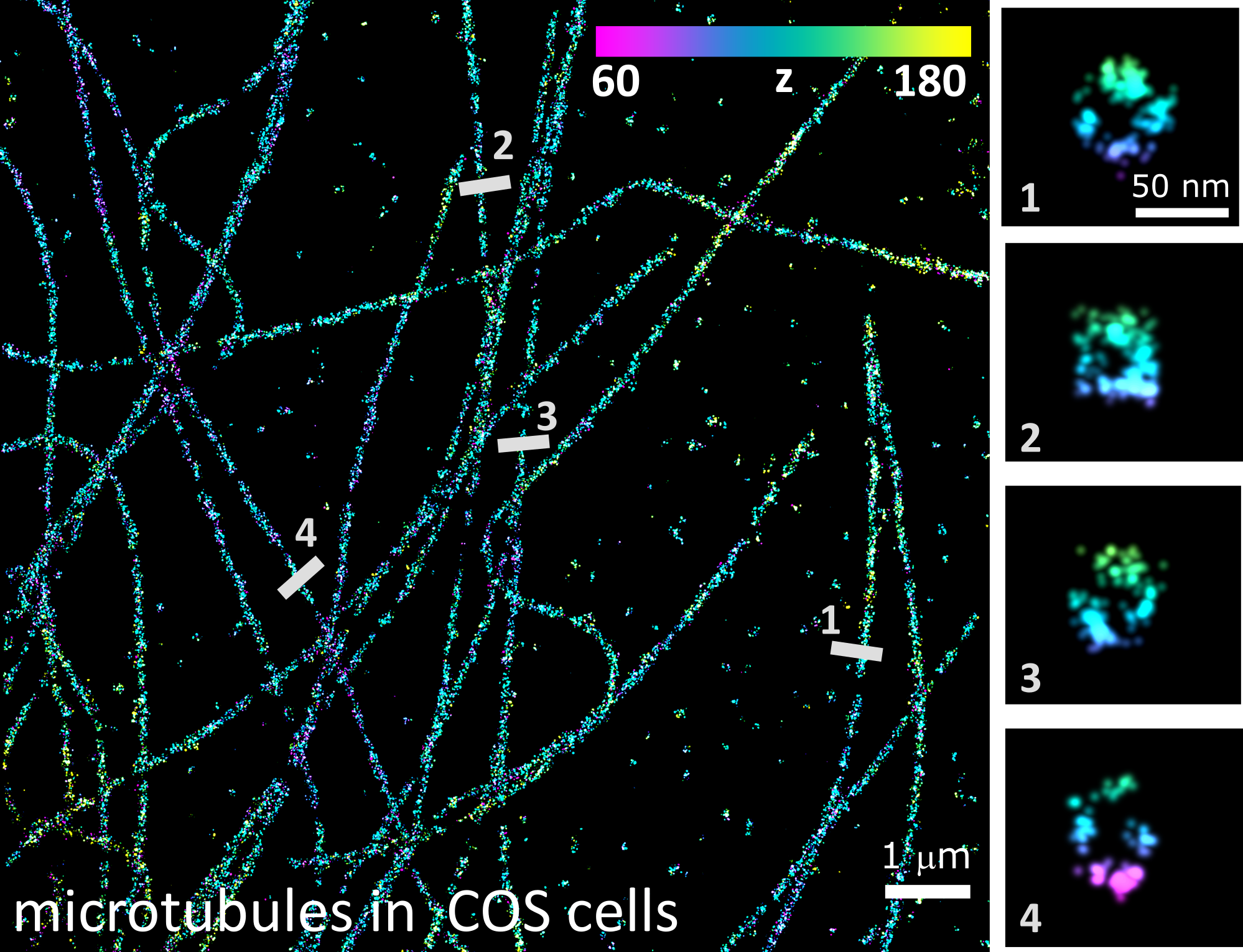
Single-molecule localization microscopy methods, such as STORM and DNA-PAINT, belong to the most widely used techniques of fluorescence nanoscopy because they provide very good spatial resolution with a simple experimental set-up. STORM reaches lateral resolutions < 20 nm, and DNA-PAINT < 10 nm. However, achieving the same level of resolution in the axial direction of [...]

A new MINFLUX approach, simpler set-up and with lifetime information!

2021-03-20T19:54:49+00:00December 19th, 2020|

Since its presentation in early 2017, MINFLUX has generated a lot of interest in the bioimaging community because it enables the localization of single fluorescent molecules with the highest precision, namely 1 nm or less, which is the size of the photon emitting conjugated systems in molecules. However, since then, no other lab in the [...]

Go to Top